
Key points of Ember Fertility’s Egg Bank
- A diverse pool of screened egg donor candidates in our frozen donor egg database.
- FDA-compliant infectious disease & genetic testing.
- Rapid, efficient “ready-to-use” frozen egg donor bank program.
- Streamlined path to parenthood using a donor egg with comprehensive intended parent support.

At Ember, everyone is a VIP – very important patient
And we have a thing for the small things: Each Ember patient gets a dedicated fertility coordinator, a patient’s personal care guide through every clinic detail, from the very first phone call to meeting your little miracle. Schedule your appointment today using our online self-scheduling tool.
Ready-to-use frozen donor eggs are available now from our egg bank, with pricing starting at just $3,199
Transparent donor egg bank pricing for your peace of mind
At Ember, we believe in market transparency and accessible care. Our donor egg pricing is designed to be fair and straightforward to help you plan your future with confidence.
Take the first step toward making your dream of becoming a parent a reality through egg donation. Whether you are a single parent by choice, part of a same-sex couple or facing specific fertility challenges, the team at Ember Fertility Center (EFC) is here to support you on your unique journey to parenthood.
Related reading: Ember Promotions
Related reading: Understanding IVF Costs
Discover your options with Ember Fertility’s Egg Bank
EFC’s Egg Bank offers a diverse selection of donor eggs from carefully screened egg donors of various ethnic backgrounds. To ensure the highest standards of care and peace of mind, all donor eggs come with comprehensive documentation about the donor:
- FDA-required infectious disease screening: Rigorous health checks to ensure the highest safety standards.
- Psychological evaluation: Thorough assessments to support the emotional well-being of all parties involved.
- Genetic carrier screening reports: Detailed insights to help you make informed decisions for your future family.
- Detailed egg donor profiles: Comprehensive information to help you find the right match.
What happens next? A step-by-step guide to using Ember Fertility’s Egg Bank
Once you have selected your donor eggs, you may wonder about what’s next. Here is a guide to the typical process.
Step 1: Complete the male partner’s fertility evaluation
The intended parent or male partner must complete a consultation with our physician and the fertility pre-screening process, which typically includes:
- Semen analysis.
- Infectious disease testing (must meet FDA requirements if using a gestational carrier).
- Genetic carrier screening to compare results with the egg donor and minimize shared recessive risks.
Step 2: Determine how many donor eggs to purchase
There is no single number that is right for every intended parent. As a general starting point, 6-8 mature donor eggs is often considered a reasonable minimum, but the ideal number depends on your individual circumstances, family-building goals and tolerance for financial risk.
Here are several important factors to consider:
Step 2: Donor egg fertilization and embryo creation
Once screening is complete, the male partner or sperm donor will provide a fresh or frozen semen sample. The selected donor eggs are thawed, and intracytoplasmic sperm injection (ICSI) is performed. The resulting embryos are cultured in our laboratory.
Rapid timeline from donor egg bank to embryos: Once you select your donor eggs, it can take as little as one week from sperm collection to blastocyst-stage fertilized embryos.
Step 3: Decide on preimplantation genetic testing (PGT)
If you wish to know the sex of the embryos or select a specific gender for family balancing, we biopsy the blastocysts (matured embryos) for PGT. If you have no preference, PGT may not be necessary as egg donors typically have a lower risk of chromosomal abnormalities. Our fertility expert Dr. William Freije can help determine whether PGT is appropriate for your specific situation.
According to American Society for Reproductive Medicine guidance, younger egg donors generally have a lower risk of age-related chromosomal abnormalities. All donors in our egg bank are under the age of 35 at the time of egg retrieval, and more than 95% are under 30. Therefore, embryos created from these donor eggs may not necessarily require PGT-A solely for the purpose of screening for chromosomal abnormalities.
Step 4: Determine who will carry the donor-egg pregnancy
The final step is deciding who will carry the pregnancy:
- Partner/intended parent: Carrying the pregnancy through a frozen embryo transfer (FET).
- Gestational carrier (surrogate): Working with a gestational carrier/surrogate to bring your child into the world.
Fast facts on Ember Fertility’s donor egg bank
Sample frozen donor egg bank profiles
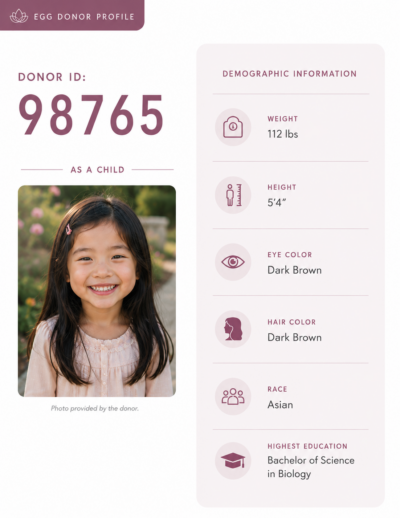
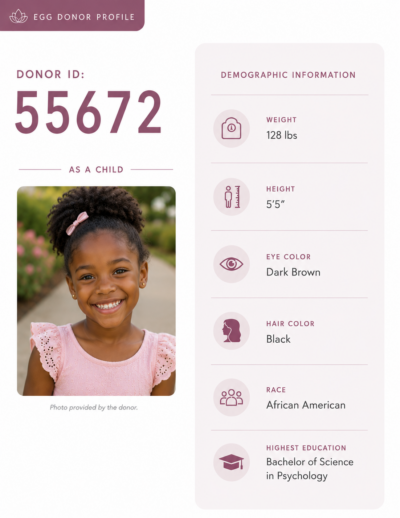
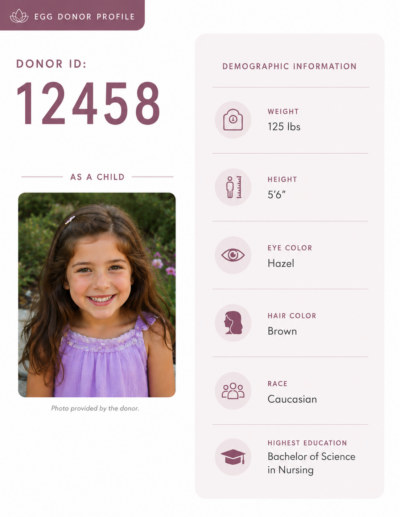
Curious what details are available in our donor egg database? Profile stats include the egg donor’s childhood photo, physical characteristics like ethnicity, height and eye color, and other quality details like education.